No Fish Selfies Allowed! 8 Laws That Can Cost European Travelers Big
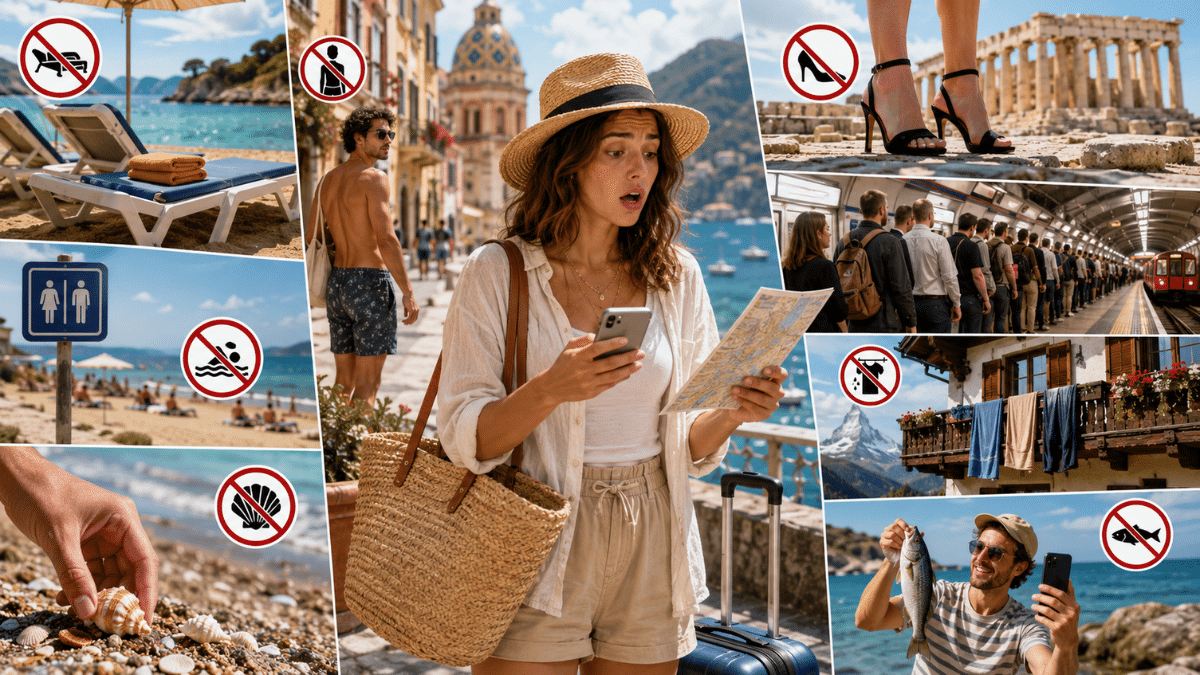
A shell souvenir from the beach, a wet swimsuit drying on the balcony rail, an early-morning dash to claim a pool lounge chair before anyone else wakes up—all pretty normal vacation habits. Except not everywhere. In several European countries, exactly these small things carry real rules that American, Canadian, and other travelers rarely know about—with fines ranging from a couple hundred to over $1,600, and in a few extreme cases, jail time. Travel insurer Tiger.co.uk rounded up eight of them. As good a reason as any to pack a little local know-how along with the sunscreen this summer.
Worth knowing: travel insurance generally won’t cover costs or losses that result from breaking the law. So if you want your medical coverage or trip-disruption protection to actually hold up, it pays to get familiar with local rules before you go.
1. Spain: Reserving a Lounge Chair Now Comes With a Fine
In tourist hotspots like Barcelona and the Costa Blanca, the classic early-morning towel dash to claim the best lounge chairs is now officially off-limits: reserving a sunbed without actually using it can cost you a fine of up to €250. The rule followed a wave of complaints about chairs sitting reserved—and empty—for hours.
Tip: Just show up early yourself for the pool or beach—reserving a spot with a towel in advance isn’t an option anymore.
2. Italy: Swimwear Stays at the Beach or Pool
In Italy, wearing swimwear outside the beach or pool is considered inappropriate. In popular destinations like the Amalfi Coast and Sorrento, violations can bring fines of up to €500—think strolling through the old town in a bikini or walking around a café topless.
Tip: Throw a T-shirt and shorts or a skirt over your swimsuit before heading to a restaurant or wandering through town.
3. Portugal: Not in the Sea
If you’re at a Portuguese beach and nature calls urgently, find the nearest restroom first: urinating in the sea is illegal and can carry a fine of up to €750. Pregnant travelers are reportedly exempt from the rule.
Tip: Beach bars and public restrooms are well marked at most Portuguese beaches.
4. Greece: No High Heels at Ancient Sites
At historic sites like the Acropolis or the Theatre of Epidaurus, high heels are banned outright—they protect the fragile, thousands-of-years-old surfaces from erosion and cracking. Sitting on ancient monuments is also discouraged, honoring preservation efforts.
Tip: Pack flat, sturdy shoes for ruins and archaeological sites—your feet will thank you on the uneven ground anyway.
5. England: Queue, Don’t Cut
In the ticket halls of the London Underground, the rule is simple: join the back of the line, no exceptions. Cutting the queue runs against a British rule meant to prevent frustration and conflict among passengers.
Tip: This one basically applies across the UK as an unwritten law—queues are treated with remarkable seriousness there.
6. Switzerland: Rules for Laundry and Fish Alike
Hang your wet swimsuit out on the balcony on a Sunday in Switzerland, and you’re breaking the day of rest—laundry lines are supposed to stay empty that day. And anglers, take note: taking a selfie with a fish before releasing it back into the water is considered unnecessary distress to the animal, and it’s banned too.
Tip: Dry towels and swimwear indoors or on a drying rack in your room if it happens to be Sunday.
7. Turkey: Watch Yourself Around Money and Atatürk
In Turkey, damaging currency is treated as a serious offense against the state and its flag—in extreme cases, it can carry up to three years in prison. It gets even more serious when it comes to insulting Mustafa Kemal Atatürk, founder of modern Turkey: penalties there can reach up to five years behind bars.
Tip: Treat Turkish currency with care, and steer clear of political commentary about Atatürk—the simplest way to stay safe.
8. France: No Beach Souvenirs
Packing up sand, shells, or pebbles as a keepsake is strictly banned on French beaches—it’s part of coastal protection efforts. Take a large enough quantity that it looks like it’s meant for commercial use, and you risk a fine of up to €1,500.
Tip: A postcard or a photo does the same job as a memento—with zero fine risk in your suitcase.
Bottom Line: A Little Research Goes a Long Way
Ian Wilson, travel insurance expert at Tiger.co.uk, put it simply: what’s harmless back home can be taken very seriously somewhere else. Few tourists set out to break the law purposely—most trouble comes from simply not knowing the local rules. A brief look at your destination’s customs deserves a spot in your packing routine, right next to the suitcase itself.
Note: Many of the rules above are local ordinances or customs rather than nationwide statutes, and enforcement can vary by region.