Fiji Islands for a paradise vacation
The Ultimate Travel Guide
More than 330 islands, turquoise waters, coral reefs in every shade of the rainbow, warm-hearted people, a culture going back thousands of years—and best of all for European travelers: no visa required. The Fiji Islands rightly count among the most beautiful destinations in the world and are a dream for anyone who wants to experience the supposed end of the world in its most paradisiacal form. This in-depth guide covers everything you need to know for your Fiji holiday—from entry formalities to the most beautiful islands, customs, activities, and culinary highlights.
Location, geography, and a quick fact file
Fiji lies around 2,000 kilometers northeast of New Zealand in the heart of the South Pacific. The island nation consists of 333 islands, only about a third of which are inhabited. The two main islands, Viti Levu and Vanua Levu, together account for roughly 87% of the country’s land area. The capital, Suva, is on Viti Levu, while the international airport at Nadi sits on the western coast of the same island. About 900,000 people call Fiji home—a colorful mix of Indigenous Fijians (iTaukei), Indo-Fijians, Chinese, Europeans, and people from other Pacific nations.
The country’s highest peak is Mount Tomanivi at 1,324 meters—an extinct volcano on Viti Levu, revered as a national symbol. Volcanic activity has shaped the islands over millions of years: rugged mountain ranges, fertile highlands, dense rainforests, and, of course, the famous white sand beaches with their offshore coral reefs.
Entry, visa, and formalities
EU travelers have it easy: a passport valid for at least six months beyond your stay, plus a return or onward ticket, is all you need. On arrival you receive a tourist visa allowing you to stay visa-free for up to four months. An extension is possible for a fee at the immigration office.
It pays to have the address of your first accommodation and your return ticket easily accessible at the airport—officials sometimes ask for them. An electronic arrival form usually has to be filled in online before departure, so make sure to take care of this in advance.
Health and vaccinations
Fiji is considered a relatively low-risk destination from a medical perspective. Mandatory vaccinations apply only if you arrive from a yellow-fever area—in that case, proof of vaccination is required. Travelers coming directly from Europe often don’t need this. Recommended are the standard immunizations (tetanus, diphtheria, polio, MMR) as well as hepatitis A. For longer stays or off-the-beaten-track travel, hepatitis B, typhoid, and rabies are worth considering.
There is no malaria in Fiji, but dengue fever occurs seasonally—good mosquito protection with DEET-based repellents, long-sleeved clothing in the evenings, and a mosquito net in simpler accommodations are therefore essential. Outside larger hotels, drinking water should be boiled or bottled.

Ad
Money, payment, and tipping
The currency is the Fijian Dollar (FJD). The current exchange rate is roughly 1 EUR = 2.30 FJD, though rates fluctuate. ATMs are plentiful in Nadi, Suva, and the main tourist areas, and credit cards are widely accepted in hotels, resorts, and upmarket restaurants. On more remote islands, however, you should always carry enough cash—many places only take payment in person.
Tipping is not mandatory in Fiji but is appreciated. Many resorts run a central “Christmas Box” that staff share at the end of the year—a lovely cultural tradition. In restaurants, 5–10% is generous.
Power, internet, and connectivity
Mains voltage is 240 volts at 50 Hz, with the Australian three-pin plug (Type I). If you don’t have an adapter, you can buy one cheaply on arrival. Mobile phone coverage is reliable on the main islands—providers such as Vodafone Fiji and Digicel sell tourist SIM cards with data packages directly at Nadi airport. Out in the remote Yasawa or Lau islands, however, the network can be patchy—something most travelers welcome as a chance to disconnect.
Language and communication
Fiji has three official languages: English, Fijian (iTaukei) and Hindi. English will get you anywhere in tourism without trouble. A few words of Fijian, however, go a long way:
- Bula! — Hello / Welcome / To life (probably the country’s most important word)
- Vinaka—Thank you
- Vinaka vakalevu—Thank you very much
- Moce (pronounced “moh-thay”)—Goodbye / Good night
- Io— Yes / Sega—No
A friendly “Bula!” will be beamed at you a hundred times a day on every island—Fijians rightly have a reputation as one of the friendliest peoples on Earth.
Best time to travel and climate
Fiji lies in the southern hemisphere and has a tropical climate. There are essentially two seasons:
The dry season from May to October is considered the best time to travel—conveniently coinciding with the European summer. Daytime temperatures sit at a pleasant 25–28 °C, humidity is lower, and the sky is usually a brilliant blue. Divers and snorkelers will love this period because visibility is at its peak.
The wet season from November to April brings higher temperatures (28–32 °C), tropical afternoon showers, and the occasional cyclone—especially in January and February. On the upside, most cultural festivals take place during this time, the vegetation is at its lushest, and prices tend to be lower. If you’re after the full cultural program and don’t mind the showers, this is your window.
A handy rule of thumb: Fiji’s summer falls in the European winter (festival season), while the European summer brings Fiji’s dry season with picture-postcard weather. For classic beach and dive holidays, June to September is prime time.
The most beautiful island groups at a glance
Viti Levu—the lively main island
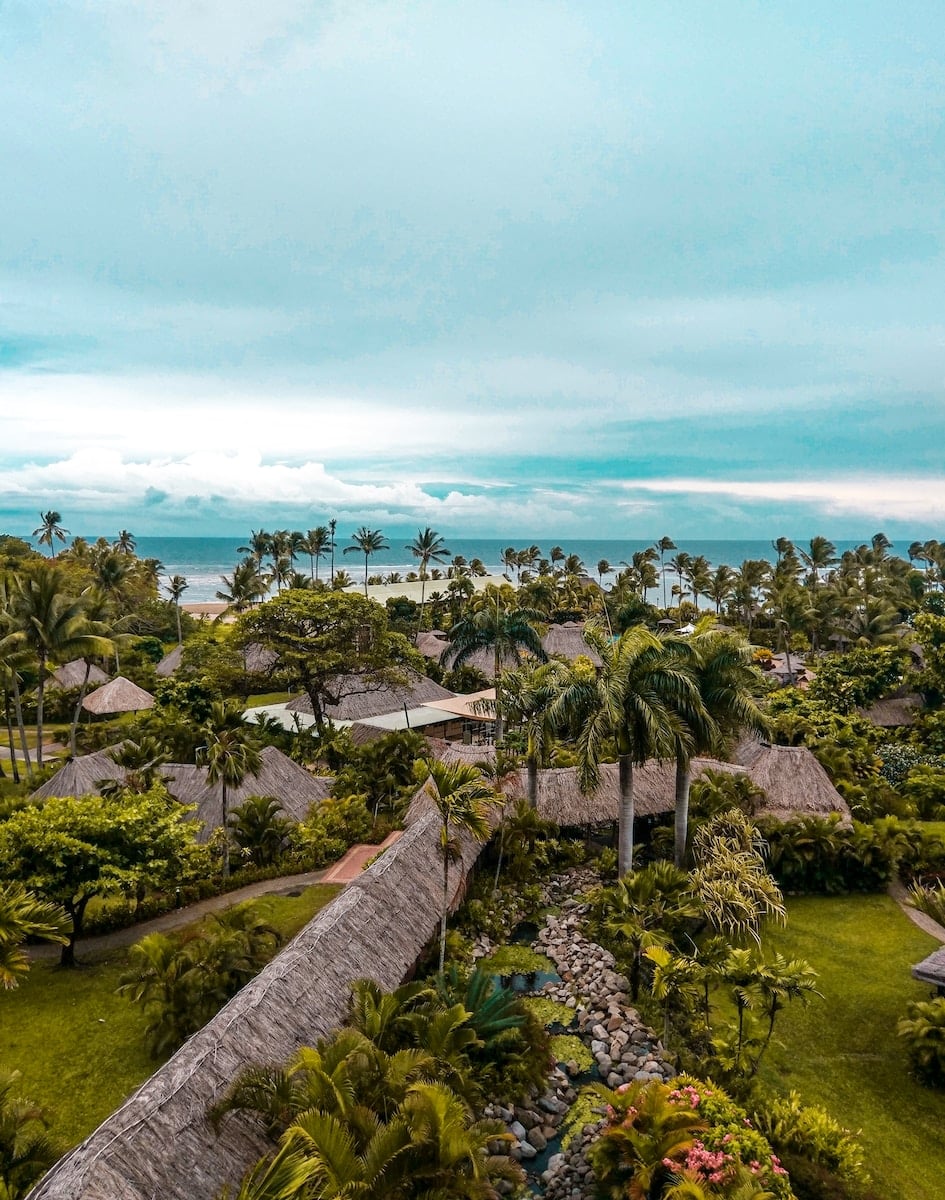
The largest island is your point of arrival, transport hub, and a varied destination in its own right. The west around Nadi holds most of the resorts and the international airport; the south around Pacific Harbour is an adventure hotspot with rafting, shark dives, and quad tours. The capital, Suva, in the southeast, shows off Fiji’s urban, multicultural side with colonial buildings, markets, and the excellent Fiji Museum. Inland, the Sigatoka Sand Dunes National Park, the Namosi Highlands with dense rainforests, and the famous village of Navala—one of the last entirely traditional bure (thatched-hut) villages—await you.
Vanua Levu—the unspoiled second island
Quieter and far less developed than Viti Levu but full of charm, Savusavu, with its hot springs, is the gateway to dive trips at the Namena Marine Reserve. If you want to step away from mass tourism, this is the place.
Mamanuca Islands—picture-perfect paradise on the doorstep
The island chain west of Nadi is one of Fiji’s iconic backdrops. “Cast Away” with Tom Hanks was shot here (on Modriki Island). The Mamanucas are perfect for shorter stays, day trips, or all-inclusive resorts on your own mini-island.
Yasawa Islands—rugged beauty for romantics
North of the Mamanucas, the Yasawas reveal Fiji’s wilder side: volcanic cliffs, lonely bays, and luminous blue lagoons. “The Blue Lagoon” with Brooke Shields was filmed here. The Yasawa Flyer, a daily ferry with the “Bula Pass”, makes hopping between islands easy—ideal for backpackers and island romantics.
Taveuni—the garden island
Taveuni is regarded as Fiji’s greenest island and a true nature paradise. The Bouma National Heritage Park with its three waterfalls, the Lavena Coastal Walk and dives in the Somosomo Strait with its famous Rainbow Reef make it a highlight for active travellers.
Kadavu and the Lau Islands—far from it all
If you really want to get off the grid, fly to Kadavu and dive the Great Astrolabe Reef—one of the world’s largest barrier reefs—or head out to the rarely visited Lau Islands in the east, where old Polynesian Fiji still lives on undisturbed.
Ads
Activities and experiences
Diving and snorkeling—Fiji is world-class
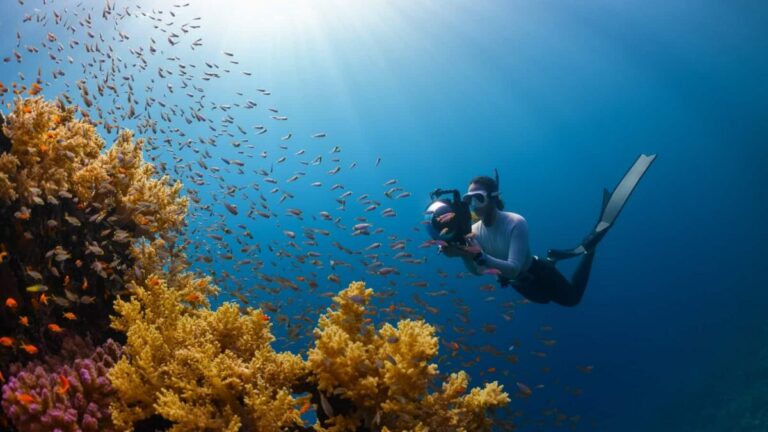
Fiji is known as the “Soft Coral Capital of the World”. More than 1,500 species of fish, sprawling coral gardens, and crystal-clear water make this one of the planet’s top dive destinations. Highlights include the Rainbow Reef in the Somosomo Strait, the Great Astrolabe Reef off Kadavu, and the Bligh Water between the main islands. Snorkelers, too, will be in heaven directly off many resort beaches.
Surfing
Cloudbreak off Tavarua Island delivers one of the most spectacular waves on Earth—pro surfers travel halfway around the world for it. There are also plenty of moderate spots for intermediate and beginner surfers.
Hiking and nature
Climb Mount Tomanivi, trek through Koroyanitu Heritage Park, follow the waterfall trail at Bouma on Taveuni, or raft down the Navua River through tropical gorges—beyond the beach, Fiji is also a fantastic active destination.
Adventure and water sports
Shark dives with bull sharks at Pacific Harbour, jet ski tours through the Mamanucas, stand-up paddling, kayaking trips between deserted islands, and deep-sea fishing for marlin and tuna—the list goes on.
Cruises and island hopping
Multi-day cruises with Captain Cook Cruises and Blue Lagoon Cruises through the Mamanucas and Yasawas are a relaxing way to see several islands in one trip. If you’d rather stay flexible, take the Yasawa Flyer with a “Bula Pass” and hop from island to island at your pace.
Ads
Culture and traditions—the heart of Fiji
The kava ceremony
The most important cultural ritual is sharing kava (also called yaqona), a mildly sedative root infusion. If you’re welcomed into a traditional village, you’ll go through a sevusevu ceremony: you bring a bundle of kava root as a gift to the chief and drink with the community from half a coconut shell. A unique experience—and a sign of deep mutual respect.
Meke—dance and song
Meke is the traditional dance form in which Fijians tell stories of war, love, gods, and ancestors. Backed by rhythmic drumming and chanting, a meke performance is a cultural highlight at many resorts and festivals.
Lovo—the earth oven feast
A lovo is Fiji’s traditional banquet: pork, chicken, fish, and vegetables are slow-cooked for hours in a pit lined with hot stones and wrapped in banana leaves. The result is a smoky, deeply flavored experience you simply shouldn’t miss.
Festivals and public holidays
- Bula Festival in Nadi (July)—the country’s biggest popular festival
- Hibiscus Festival in Suva (August)—with parades and beauty pageants
- Diwali (October/November)—the Hindu festival of lights of the Indo-Fijian community
- Holi (February/March)—the festival of colors with exuberant powder-throwing
- Fiji Day (10 October)—national day with parades and dancing
Visiting a village—a few etiquette rules
If you visit a traditional village, keep a few rules in mind: cover shoulders and knees, remove your hat (hats are reserved for the chief), no sunglasses when speaking with elders, and always bring a small sevusevu gift. Treated with respect, you’ll be welcomed with hospitality that’s difficult to match anywhere else in the world.
Cuisine—more than coconut and fish
Fijian cuisine is a melting pot of Melanesian, Indian, Chinese, and European influences. Don’t miss:
- Kokoda—the national dish: raw fish marinated in lime juice and coconut milk (similar to Peruvian ceviche)
- Rourou—creamy taro leaves cooked in coconut milk
- Curry—Indo-Fijian cuisine offers excellent lamb, chicken, and fish curries with roti
- Babakau—Fiji’s deep-fried, slightly sweet bread
- Fresh tropical fruit—papaya, mango, pineapple, passionfruit, and the sweet “Fiji apple”
Getting around
The two main islands have a road network of around 5,000 kilometers, much of it paved. Rental cars are easily available in Nadi and Suva—you drive on the left (a British legacy). For island hopping, you can take ferries, the Yasawa Flyer, or the small water and bush planes operated by Fiji Link. Short distances are best covered by bus or shared taxi (carrier).
Tips for your Fiji holiday
Pack a lightweight rain poncho—tropical showers are short but heavy. Sun protection is essential: equatorial UV is intense, and reef-friendly sunscreen also protects the corals. Don’t try to cram too much into your itinerary—Fiji runs on “Fiji Time,” the pace is gentle, and that’s precisely the point.
If you want to see more than two islands, plan for at least 10–14 days. For a full trip combining the main islands, the Yasawas, and Taveuni, three weeks of tropical downtime is even better.
Conclusion
Fiji is more than a pretty beach destination—it’s a vibrant slice of South Sea culture with stunningly intact nature, one of the warmest populations on Earth, and countless layers between remote castaway bliss and world-class resorts. Whether you come as a diver, surfer, hiker, honeymooner, family traveler, or curious culture enthusiast, the Fiji Islands* hold their version of paradise ready for you.
Bula vinaka—and safe travels!